Sunday, July 3, 2011

decoration_mini manifesto

work in progress...

In roaming around the several cities we have visited, I have come to the conclusion that preservation is multi-layered and complex. A simple assessment, I will admit, but it seems to be the most fitting response when working through this controversial topic.


Preservation indicates value, significance and importance, elements that are more sentimental and ephemeral than they are tangible. The idea behind preservation concurrently tugs at the what (the site), the who (the people directly/indirectly involved or affected) and the why (the characteristics of the area that makes it worth saving). Historic and cultural relevance play an important role as well as the promotion of certain lifestyles or social interactions related to the space or site.


In protecting the old in the new world, decoration plays a major role in enhancing attractiveness for tourism and business, and stimulating a sense of national identity. It does more than make a space look nice or authentic; decoration is the primary introduction to the preserved space and acts as a narrative that is carried out throughout the site. Decoration works as both a preservation tool and as an aesthetic tool to protect, or even re-manufacture, the historic and cultural relevance of the space or site.


In the realm of preservation, decoration is a strategy to maintain the old all in itself, but for the different sites, the tactic for preservation varies. In the course of this studio, I have identified ten sub-strategies folded under the decoration umbrella: Replication, Drag-And-Drop, Definition, Embellishment, Camouflage, Place Holder, Excessory, Façade, Art...and something else. (smiley face)

ARCHITECTURAL –SPIRITUAL-COMMERCIAL CONSUMPTION

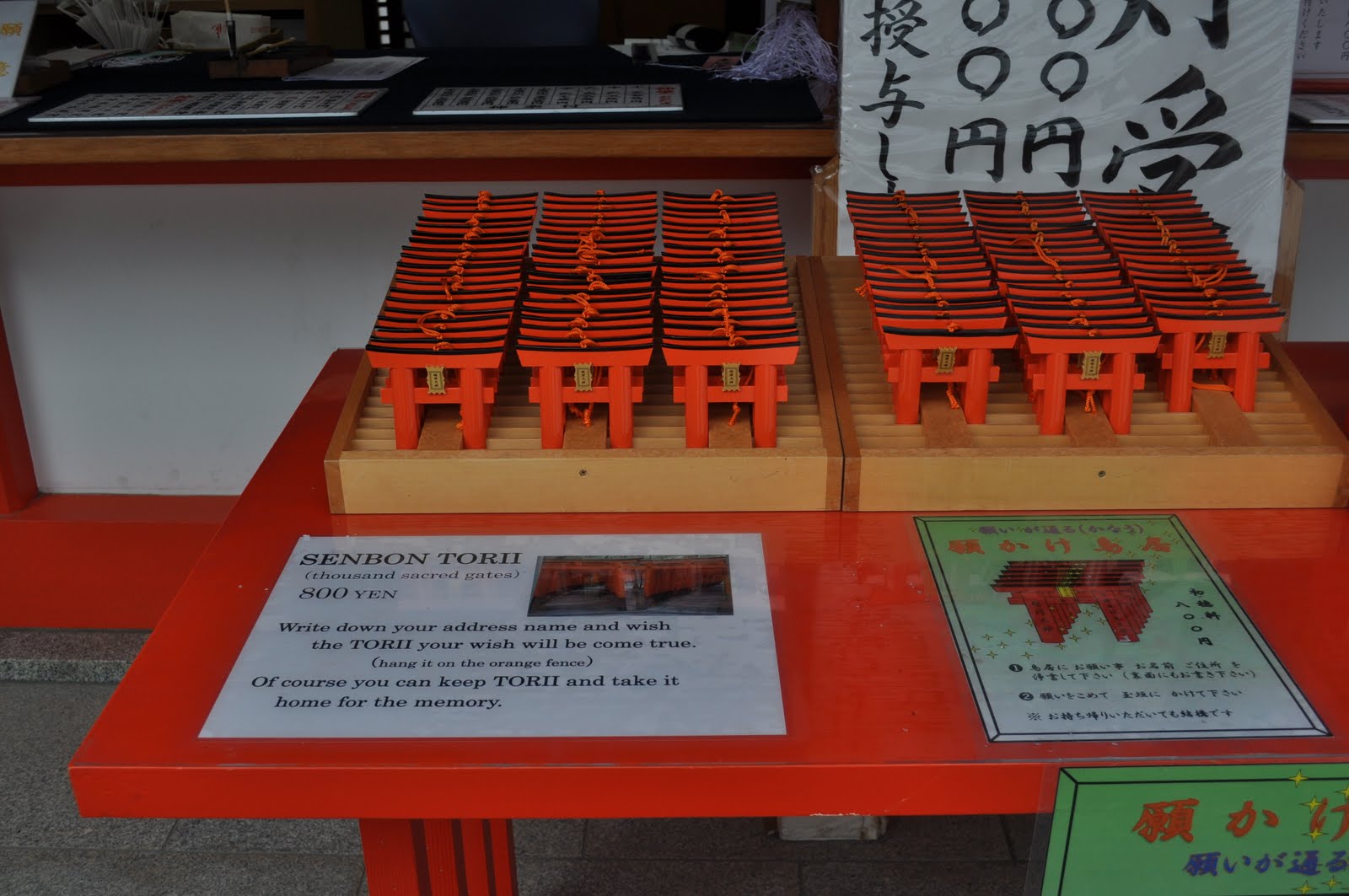
The Fushimi Inari shrine is the head shrine of the largest shrine network in Japan today, and the shrine is dedicated to the kami Inari, patron of agriculture and business. The shrine is perhaps most famous for its torii paths, which are lined with hundreds of torii, creating an orange corridor for worshippers on their way to the various small shrines that dot the mountain. Each torii is purchased by a certain business hoping for Inari’s patronage and protection. At Fushimi Inari, an entire culture exists to sell charms of various levels to worshippers hoping to gain Inari’s favor. At the low end, one can purchase a name tag or a miniature torii for a couple of hundred yen. These are then hung at certain places. At the high end, one can purchase a real life sized torii for hundreds of thousands of yen. These purchase comprise the entire architectural landscape. The real life sized torii form the corridors of mountain trails; the smaller one necessitate bulletin board like structures to hold and display them. The head shrine located at the foot of the mountain serves to draw worshippers in, and the torii lined paths serve as both tourist attractions and guiding channels for worshippers of various smaller shrines.

This mechanism of architectural production and survival (as there will always be businesses looking to purchase one for good fortune) has been in place for a very long time and really is a survival mechanism founded on a certain spiritual desire of the worshippers that is eternally human and perpetually extent. In other words, these torii architecture will always remain and grow (i.e. survive) for as long as people believe in the power of Inari (even for lack of a better alternative). The tectonic strategy is almost akin to the metabolist mode, where you simply have a bunch of premade units that you simply add on as you require. This is perhaps a super species strategy, as there seems to be no sign of decay for these torii. It’s just as easy to put one up should one fall down, and the mechanism seems to be going strong. It’s interesting to note that where traditional building survival is realized, some sort of commercial incentive is in place. Except at Fushimi Inari Daisho, the commercial incentive is ultimately spiritual.


Supplement - strategy- protection

At the old summer palace, which was once a private recreation area of the imperial family in Beijing, we encountered an instance of preservation that seemed only appropriate at a popular tourist destination in China, with an everlasting, overwhelming amount of visitors. Due to a frantic desire to protect historical sculpture while stressing the authenticity of it and opening it up to the public, a compromise was struck: the result was an encasement of a bronze crane in an intimate wire mesh cage in the shape of the sculpture, fenced off from direct access. From afar, one could hardly figure out if the cage was part of the sculpture as it became a mutated, caged crane that stood out from the cluster of similar sculptures. This is an example of how the old is being protected by a new membrane/supplement, which tries not to suppress or overwhelm the old, perhaps not with much success. Clearly, this protective shield also became a device to lure the attention of passing tourists by stressing the value of it--by look but no touching, without sacrificing the original form of the sculpture enclosed within. It's no surprise that it was the one of the most crowded sites for photos in the garden, so one could conclude that highly protected objects or sites draw in spectacle, and spectacle draws in more spectacle. It seems that the sculpture preserves itself by asserting its physical dominance over others, or by increasing the lifetime of the sculpture. Layers of protection- the pestal, steel fence, and wire mesh cage give the sculpture a sense of significance and authority, and creates boundary and distance between the viewer and the displayed object, turning it into an isolated, permanent object that is untouchable and distant. In contrast to the old summer palace (yuan ming yuan), visual aspects ranging from sculptures to natural landscapes are protected and choreographed more carefully to accommodate the large flow of tourists.

procession part i - natural procession at arashiyama


having both read about and being told about the reknowned bamboo forest at arashiyama, i decided to spend the afternoon there and see what all the fuss was about. the journey to arashiyama was straightforward enough, but once i arrived i had to ask for directions to the forest since i couldn't understand the japanese map. the station attendant told to me follow the main road for about 500 m and then i would see the entrance to the forest on my right. it took a while to actually find it since the entrance is not clearly marked, and sort of just quietly branches off from the main road.

hang on a second, why does something naturally occurring like a forest need an artificially designated entrance?

and why is there a paved concrete path running through it, flanked on either side with 6 foot tall fences?

the forest itself is completely blocked off from public access; you are only free to experience it from the path cutting through the bamboo trees designated by... well i'm not really sure who by. yes, the view from the artificial path isn't exactly bad, but i would much rather be able to freely walk amongst them, choose my own path, and perhaps even (gasp) touch them. what's more, the paved path only extends some 4-500 metres (i estimate) up a hill, and then you arrive at the observation deck where you are presented with this view:

and then it's time to turn around and go right back down the way i came. hang on another second, LOOK AT ALL THOSE TREES! oh wait, i can't get to them. drats, time to go home then.

sure, it's a pretty view, but it still doesn't disguise the fact that the so-called "bamboo forest" seems less of a forest and more of just a mountain (hill) path with bamboo trees planted on either side. and i would dare even to say that the trees are subservient to the path itself. truly, i wonder which came first, the path or the trees?

regardless of my cynicism, the natural (but artificial) procession and repetition of the bamboo trees generates a vertical rhythm that is, for lack of a better word, quite magical:

the repetition of the slim vertical trunks creates a grill that selectively lets light in, which, coupled with the natural filigree of the canopy above, generates a beautiful, almost ephemeral, illuminance. it is easy to see the appeal of using bamboo as a structural material and/or emulating such an effect in asian architecture, such as at the entrance of our kyoto hotel:


this is the first of a two part post which will be followed up by the artificial procession of the "thousand toriis" at fushimi.

decoration_excessories


This weekend, we went down to the Geisha district in Kyoto. It is the largest district where geishas entertain their clients, but the business/career itself is very small and is declining. In efforts to rehabilitate the lifestyle, there was a major development of certain streets (identified by their cobblestone paving) that turned original private machiya houses into small and eclectic restaurants and bars. In restoring this area with elements of the "old", the whole neighborhood is more or less very new looking. And because it is not used for what it used to be used for (lower income housing, small tea shops and stores) it in itself is a decorative object. The interaction with the space itself is minimal (used by tourists, geishas, and business men at certain times of day). Its an excessive addition to the fabric of Kyoto, an artificial revival of a lifestyle more than that of a place.

Also this screen motif, as a traditional aspects of the machiya houses, was quite overplayed, (incorrectly at times) but was a major player in making this area appear "old" and refurbished.

Friday, July 1, 2011

LOTS of Assembly Required


East Asian architecture is known for its intricate detailing, particularly when it comes to the roofs. Hundreds of thousands of pieces of wood, metal, and tiles go into completing a roof, and the need to create height and grandeur, as architecture (most prominent in the roof) is a status indicator, necessitated bracketing, layering, carving, tiling, and painting on a monumental scale to create the intended effect. The assembly of such roofs took a tremendous amount of man-hours. In the Kyoto Imperial Palace, it takes about 25 years to re-roof all the buildings and each roof only lasts approximately 30 years. By the time one cycle of roff replacement is complete, another cycle has to begin again. Inbuilt into the architectural process is the ideal of maintenance, and almost by definition it is impossible for one to retain the original authentic material.

But material discussion aside, the complicated assembly process for a roof alone has some sort of preservation merit, at least for structural enthusiasts. Documented above are two examples of roof tectonic preservation, where a section of the roof detail has been preserved for the public to see. The first one demonstrates the layering of cypress bark that gives a unique and organic roof to the Japanese roofs at the Kyoto Imperial Palace. No metal is used and the entire structure is composed of layers meticulously threaded together with wood pins the size of toothpicks. The second one is from Higashi Honganji, and the Chinese style roof with its tiles reflect the flow of culture and Buddhism from the Chinese mainland.

The two roof archetypes have been displayed in detail for tourists to see exactly how these structures were built. As an architecture student, it is a lot easier to understand the section then it is to look at the complete roof and try to figure out the exact assembly. The intent of preservation is at least achieved in this regard. But, what if that was the only intent, that we only need to preserve buildings for the sake of preserving the tectonic process? Would we need the whole temple structure to remain original? An even better question is, since we do know how to construct the original structure, is it necessary that we preserve the original material assembly? If it falls, we can rebuild it again. History testifies to this and especially in earthquake prone Japan, rebuilding is the norm rather than the exception. How do we then evaluate authenticity? At the very least I suppose, the documentation of these impressive assembly structures as sectional models can be seen as a successful example of preservation. It's tectonic survival strategy is one of fetishization, where decontextuallization achieves the intended tectonic method preservation.

Ryoanji

Ryoanji is most famous for its zen rock garden, with its 15 stones over raked gravel. The only "green" in this garden is the moss, and the minimalism of zen gardens is represented here. There has been much speculation behind the layout and meaning of this garden, but the focus of this post is on the context of the garden. Behind the zen garden's walls, there exists a density of trees, of varying heights, species, and shape, all of which become edited out when looking at the zen garden and serve to contrast the white of the gravel and the sharp greens of the trees. To the right of the viewing veranda, there is an often overlooked garden, filled with the same character of trees as the ones that exist beyond the wall. It is a cooler place, with shade and grass, and again, highlights the contrast between the two. It is as if the greenery behind the wall has suddenly and unexpectedly supplanted itself within the zen garden, giving the eyes rest from the glaringly bright white gravel and shifting the background to the foreground. They are only in view of each other in the peripheral sense, and it is has greater contrast because of the shift in perception, which underscores the rock garden in its simplicity.